AI data movement

Accelerators do not work at cluster speed when the network behaves at average speed.

AI traffic is synchronized, burst-heavy and intolerant of unpredictable delay. SIDERA approaches the fabric as part of the compute system—designed for effective bandwidth, observability and operational control.

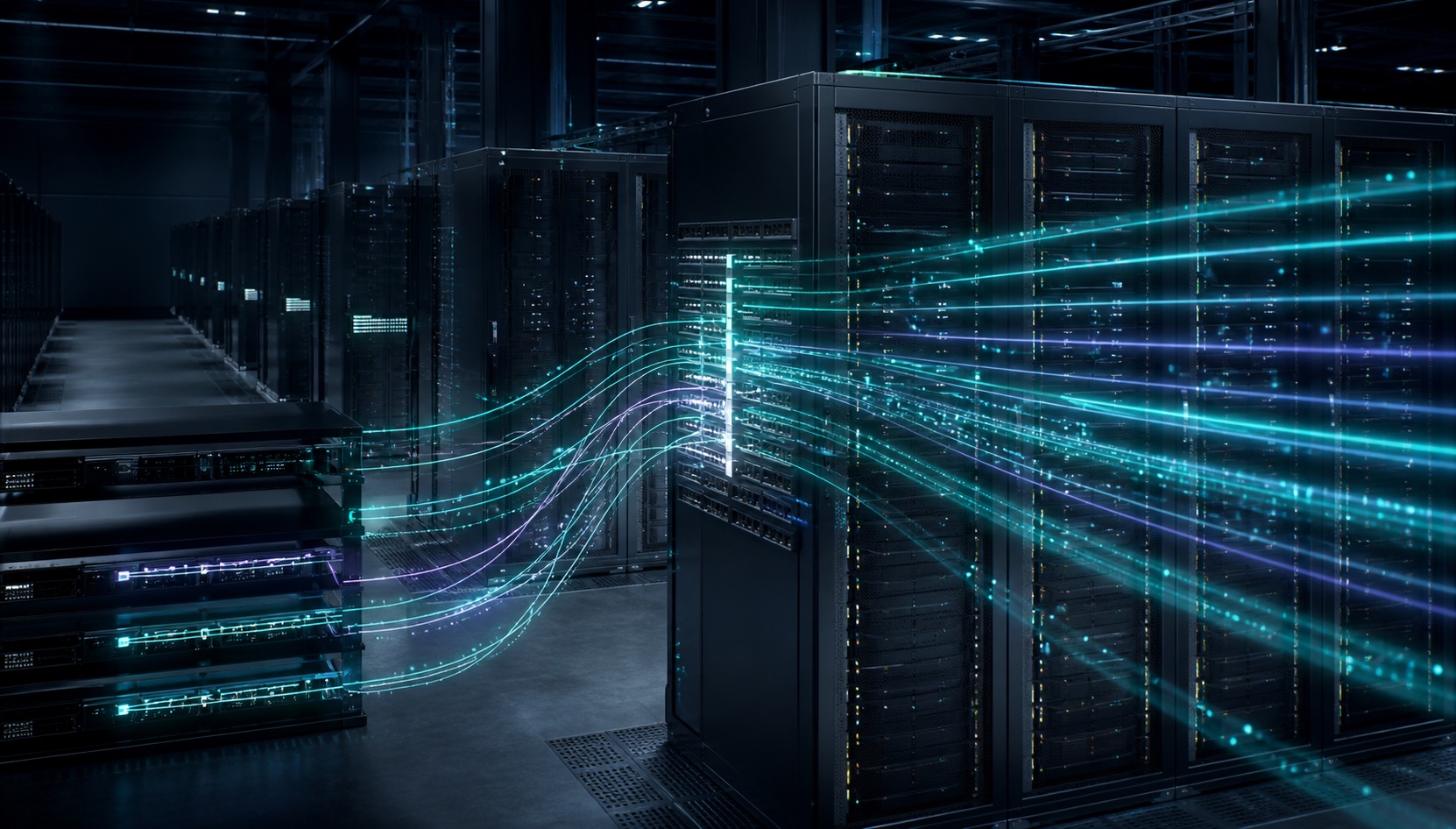
AI data streams moving across a high-capacity Ethernet fabric
INTELLIGENT FABRICPredictable movement for synchronized AI workloads.

Observe · Balance · Protect

The network challenge

AI changes what “good Ethernet” means.

Bandwidth is essential. Predictability, fast recovery and visibility determine how much of that bandwidth becomes useful work.

01CONVERGING FLOWS

Synchronized incast

Collective operations can drive many accelerators toward the same destination at the same time, filling queues faster than conventional fabrics can react.

Protect shared buffers and coordinate congestion response.
02FLOW COMPLETION

Tail latency

A small number of delayed flows can hold back an entire distributed job, extending completion time and reducing accelerator utilization.

Engineer for predictable flow completion—not only peak throughput.
03PATH UTILIZATION

Path imbalance

Static hashing can concentrate elephant flows on a subset of links while capacity remains unused elsewhere in the fabric.

Use workload-aware telemetry and dynamic path selection.
04TENANT ISOLATION

Noisy neighbors

Multi-tenant clusters need performance isolation so one workload does not create unpredictable loss or latency for another.

Segment, meter and observe traffic across the end-to-end path.
05SIGNAL VISIBILITY

Operational blind spots

Device counters alone rarely show how the network affects a training step, checkpoint or inference pipeline.

Correlate fabric, endpoint and workload signals.
06DATA PER WATT

Power and topology

Every additional tier, retimer and optical link consumes power that could otherwise support compute.

Favor efficient silicon, high radix and flatter designs where appropriate.

The SIDERA approach

Programmable fabric. Open operations. Regional accountability.

The architecture combines efficient switch silicon, flexible traffic management, open network software and end-to-end telemetry with a regional integration and support model.

Explore data center switches
01

Programmable data plane

Adapt pipeline behavior and resource allocation as AI protocols and workload patterns evolve.

02

Congestion-aware transport

Design lossless Ethernet, queue policy and load distribution around endpoint and application behavior.

03

Fabric observability

Expose high-frequency telemetry for faster correlation, fault isolation and capacity decisions.

04

Open NOS integration

Use SONiC/SAI-based options, hardened through testing, security reinforcement and lifecycle engineering.

05

Custom engineering

Modify platform, software, mechanics and management interfaces for project requirements.

Three dimensions of scale

One data strategy from rack to region.

AI infrastructure increasingly spans three connectivity domains. Each has different latency, bandwidth and failure-model requirements.

01 / SCALE-UP

Inside the compute domain

Very high-bandwidth accelerator interconnects coordinate tightly coupled processing within a system or rack.

02 / SCALE-OUT

Across the AI cluster

Ethernet connects GPU servers, storage and services through leaf-spine fabrics designed for collective traffic.

03 / SCALE-ACROSS

Between facilities

Longer-distance connectivity coordinates capacity, data and operations across sites while respecting latency and resiliency constraints.

INITIAL SILICON PLATFORMXSIGHT LABS X2
12.8Tbps full duplex
<200watts at 12.8T
<700ns latency
128×100G SerDes

First platform, open architecture

X2 for efficient, programmable data movement.

Xsight Labs’ X2 combines 12.8 Tbps switching, 100G SerDes, sub-700 ns latency and a programmable architecture with SONiC/SAI, SDK and P4 integration paths. SIDERA’s initial portfolio applies this foundation to high-capacity data center systems.

Silicon specifications are published by Xsight Labs. Final system performance and port configuration depend on the selected SIDERA platform.

Portfolio roadmap

Toward higher-radix, 102.4 Tbps-class fabrics.

Next-generation SIDERA platforms are planned around Marvell Teralynx technology, extending the portfolio toward lower-power, high-density switching for increasingly flat AI fabrics.

Read about Teralynx T100

Fabric architecture

Share the workload graph, endpoint speeds and scale target. We’ll turn them into a fabric design.

Contact the engineering team

Architecture review · Custom configurations · Regional support